 Dear Rielle,
I’m glad you went on “Oprah” this week. Ever since you burst onto the national consciousness in 2008, I’ve been wondering about you — the former Lisa Druck, now a Southern Californian named Rielle, and since last year the mother of a lovely toddler who looks just like former senator and presidential contender John Edwards.
Back then, I had a pretty good idea of who you were, and, paradoxically, none at all. Here on the WVFC website, I wrote about what your story brought to mind: “We Could All Be Elizabeth Edwards.” Like many women, I first heard the unfolding tale with that brilliant attorney and cancer survivor in mind, and felt sick. “We all could be Elizabeth: we all could see something we’ve fought for splintered in a second, because of others’ stupidity or our own. As midlife women, we curse what our bodies can no longer do or be or look like…” Or the fear that crosses the heart that someone newer and shinier can walk into your relationship and upend it.
It’s been nearly two years. For a while you were easier to ignore, what with the tawdry details spilling out of all the political press or the memoir of former Edwards aide Andrew Young, who once claimed to be your child’s father. As soon as Elizabeth finally filed for divorce, protecting her children, it was easy to decide you were none of my business.
So why turn to that hour with Oprah and your Hollywood-lovely face? Maybe because as much as I think I could have been Elizabeth, I also know I could have turned out more like you.
After all, you and I moved to California for love in 1991, though I went to San Francisco and you took up life in Beverly Hills with a new husband and a new name. I’ve also had the very experience you described to Oprah, about the day in 2006 when you met Edwards: for me it was an evening on a dance floor when “love at first sight” didn’t feel like a cliche and it seemed fine to ignore common sense. (Thank heavens, in my case the dude involved melted away after a few weeks.) “Our hearts were louder than the minds,” you said. Right. Anyway there’s a chemical name for that “wave of energy” you felt: oxytocin, the hormone that helps babies nurse and makes people newly in love forget to wash their hair.
Not that there was anything wrong with your hair today. You looked like a starlet, with the same flat smile. But the way you talked reminds me of some people I knew out West, who regarded appointments as fiction, jobs as encumbrances, and promises as suggestions. Like the guy who enticed a dear friend of mine to sell everything and move to San Jose so they could start a business together — then announced that he had a bad breakup and a twisted ankle and “wasn’t in a space to work right now.” Your jargon reminds me of the self-help pseudo-spiritual cults everywhere out there, whose members kept inviting me into “informational sessions” so I could learn about things like “the reality-tone scale.”
Some of these people were friends of mine, dance partners, lovers. Like you, they saw “seeking the truth” not as a task but a treat: “I was supporting him in his process, and his intentions never wavered. I knew that he wanted — he just had a really unique way of getting there — to live a life of truth,” you said of Edwards, with that blissed-out smile.
And this is the point where I realize: Nah, I don’t have to worry about turning into you. I’ve broken up with you. Several times.
So has Jenny Sanford, former first lady of South Carolina, who was on “The View” the day you appeared on “Oprah.” Her comment about your declaration that “I’m not a home wrecker,” was a sad laugh with a flash of anger: Commenting on you and her ex-husband’s Argentinian mistress, she said, “They weren’t 18 years old. They knew exactly what they were doing.” The other women at “The View” agreed, uniting for once before the incomprehensible.
But I don’t think what any of us say is going to make a difference. You believe that your profound spiritual connection to John Edwards is something no one else can understand. This can’t really be a letter to you, not even one of those open letters we write to politicians. Because you’ve evolved to a place where your ears cannot hear what we’re saying.
You and John Edwards — who I’m embarrassed to admit I once voted for — have been reminding me of that line from The Great Gatsby: “They were careless people, Tom and Daisy — they smashed up things and creatures and then retreated back into their money or their vast carelessness, or whatever it was that kept them together, and let other people clean up the mess they had made.” In your case, those ‘other people’ include Elizabeth; your baby daughter, Frances Quinn; and Cate, Jack and Emma Claire Edwards, now set to grow up a bike-ride away from you and the baby.
For a while, the clean-up crew included the rest of America. Knowing that, you went on “Oprah” to overcome the “false picture” that all those years of press reports had brought. But I think you did the opposite. “It was compelling TV, but in the end, Hunter didn’t seem any more understandable than when The National Enquirer first discovered her,” said TIME Magazine. Salon writer Rebecca Traister wrote: “While I understand love and desire to be viciously complicated things, and certainly do not believe all mistresses to be craven, self-absorbed or ill-intentioned, I believe Rielle Hunter to be all of those things.” And you know you’re in trouble when the New York Times‘ TV reporter compares your unblinking certainty to that of Iranian dictator Mahmoud Ahmadinejad. Your destructive capacity is narrower now than in 2006, but it’s still hard to watch.
Thank you, Rielle Jaya James Druck, for reminding us of who’s behind those wide eyes.
Now, I think, America can finally quit you.

 Much was super-informal, with benefits: e.g. I warned Paul Cox (right), who I’ve known nearly 15 years now, that he was a star of my Vietnam chapter, and as a bonus he let me see and upload some 1969 photos he’d just got hold of. (They proved what I’d always guessed: he was even more of a babe at age 19 than now.)
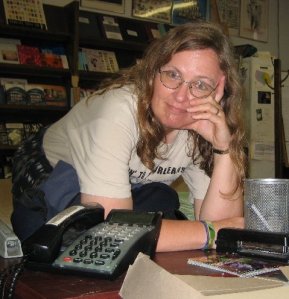 After dropping by the Women’s Caucus — where I also got to check in at the long-pervasive issue of military sexual abuse and homophobia— I got to interview
 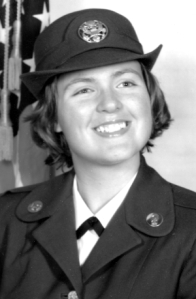 We were put on high alert; the combat troops were given orders, and up in our unit we started getting riot training.” she told me. Asked by fellow officers if women should participate, she and other women said hell yeah, we’re soldiers too — but matters never got that far. “That’s as close as I ever came to combat,” Barfield reflects now. “But – it wouldnt have been combat, it would have been killing civilians!” Already a Nation reader who’d been struck by the grinding poverty she saw in Korea, she set about upon leaving the Army to learn more about U.S. involvement in backing up Sung’s repressive government. “People are kept for so long from knowig their history,” she told me. She learned a lot from members of the then-newborn VFP such as former CIA Asia specialist aideChalmers Johnson and Brian Willson, who’d lost his legs protesting U.S. aid to repressive governments.
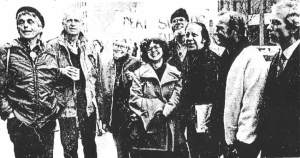 Barfield was soon drawn in by the nuclear-freeze movement, just as Philip Berrigan and the rest of the Plowshares movement were getting arrested at nuclear plants all over the country: Barfield was soon doing the same at the PANTEX plant near her hometown of Amarillo, Texas, and has been a “soldier for peace” ever since. I learned some of the latter story from a panel on nuclear-weapons issues, where a hikabusha (survivor of Hiroshima) asked through a translator what the U.S. was doing to teach its children about nuclear weapons.
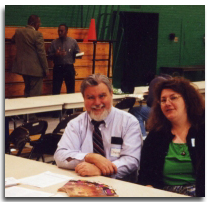 Because on my way out of town, I touched base with
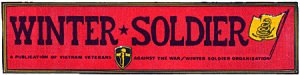 When the RU moved into VVAW’s Chicago headquarters (note the North Vietnamese star at the center of the logo), so did posters and newspapers with appropriately “militant” headlines, such as: VVAW BATTLES V.A. THUGS. A civilian volunteer named John Judge, who watched the transition, was astounded. “Were they really advocating physical violence against medical personnel?”
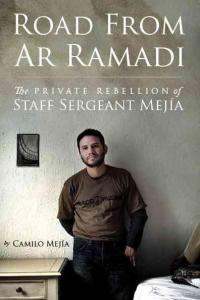 That conversation with John stayed mostly comic/elegiac. We did touch on the question I’ve since been trying, separately, to sort out: if the same has already begun to happen to IVAW, perhaps under the influence of it outgoing board president Camilo Mejia, the brilliant young scion of Nicaragua’s revolution? I mention the latter fact in full respect; Mejia (with whom I share a literary agent!) grew up in the fullness of a poet’s revolution, and his father, Carlos, wrote the Sandinista National Liberation Front’s national anthem. His speech last Thursday was compelling, as when he noted that the U.S.’ unfortunate Asian land war had left room for all the democracy movements south of the border.
 I loved this poem long before the author became one of my book’s guys (“i sing of olaf,” The Enormous Room et al.). I once asked my students, as their midterm, to explain to me how someone can write a love poem without ever using the word. Can you tell me?
 Incredible Panic Rules