 Katherine McNamara started crashing people’s expectations early – peeling off to Paris in the middle of a Cornell history Ph.D. and learning she was a poet, striking out for Alaska just as the oil boom was ending; founding one of the first prestigious literary magazines published entirely on the Internet. And ever since we met last month at WVFC’s “The Time of Your Life” luncheon, she’s been talking to us about literature, politics, publishing, why she doesn’t believe in reinvention and why her next stop might be Antarctica.
 All it takes is to read one sentence of your book The Narrow Road to the Deep North – or even your editor’s notes in your magazine, Archipelago – to know you as a poet.
My diction comes from growing up in Northeastern Pennsylvania, in an area populated by so many immigrants from Ireland, Lithuania, other countries. My valley was a very interesting place, but it was a place you had to get out of. Still, there’s something I’d call a a sort of Wyoming Valley accent that I’d never heard till last year, when I first went to Ireland, heard and heard that from people there. A familiar but half-remembered music.
You really became a poet, you said, in Paris, where you were pursuing a Ph.D. in European social history.
When I got the fellowship to go there, ,a friend shook me: “you’re not going to be like other Americans who go to Paris and sing in the metro, are you? You’re going to be a writer!” But Paris also made me realize that I could be curious, I could go out there. I learned how to be a very young, pretty girl traveling in the world: how to walk, how not to call attention to myself the way we Americans always do. I learned how to walk through the world!
 I began to feel the call as a poetry in Paris, but I didn’t really get it until I moved to Alaska.
You stayed there for seven years – supporting yourself as a poet! You also learnef a lot, you said, from visiting poets that came to the Midnight Sun Writers Conference. Those writers included people like Ted Hughes, William Stafford.
One of my first friends in Alaska turned out to be a poet, and a man in a very influential position. He invited prominent American poets to come to Alaska. And that’s how young poet learns to do poetry: you learn it from your elders!
I really did have a calling as a poet. I lived cheaply – I wmas young! I always had low overhead, slept on couches, that sort of thing. My last actual job was with the Iditerod school district.
 Along the way I met Lee Goerner, an editor from New York. It wasn’t exactly that we had a romance: I think we recognized something in each other. We married in 1988, and I began writing Narrow Road in New York in 1989.
New York in 1989 —what a culture shock after Alaska!
There’s a historian who said that “1989 was the end of the 20th Century.” That was the year th Exxon Valdez went aground; that spring the Velvet Revolution, that summer the Berlin Wall fell. And before any of that, Iran issued the fatwa against Salman Rushdie — which caused a huge roiling in publishing, struck terror in many hearts.
Lee had left Knopf, where he had been for twenty years, and became editor and publisher at Atheneum; I was offered a book contract for a book about Alaska.
But as Lee published writers he cared about, he became known as a “literary editor,” at a time when publishing was changing.
With the consolidation and conglomeration of so many companies: I didn’t know who my editor was at Viking anymore, it looked like Viking might be shut down. Lee had made his life in this; he made sense of it in a different way — until 1994, when Atheneum was shut down by a new owner. Lee didn’t work from then until the day he died a year and a half later, quite young.
I moved to Charlottesville — I had friends there, it was congenial, it was quiet. I traveled a lot, and tried to figure out what to do.
Which turned out to be — Archipelago?
I was in Los Angeles and had lunch with Sonja Bolle, who was at the time editor of the LA Times Book Review. We were talking about trade publishing, the shock to it. Meaning the loss of Lee, but also of what we called the “missing books” — that the books that you’d once call mid-list were just not appearing. So I suggested to her that once a quarter or so, she feature these unpublished books, invite a wellknown novelist to review one of two of these works becoming “our shadow lit” She laughed and said “i don’t know if we can do it, but it sounds like something you should do.” I said, “Who needs another another literary review on the newsstand?” “No,”she said – and remember, this is 1996! – “you should use the Internet. It’s too democratic. But if you’re there, we’ll know where to look.”
It was an interesting idea. I thought about it: I did have a Mac laptop 540, the Mosaic interface had by then come in… And I had a little money that I wanted to devote to in some way to books, to publishing. I corresponded with a number of writers, all of whom said – “we’ve thought about doing something like this, but you should be the one to do it.”
I ruminated and I traveled a lot, came back and hired a graphic designer to do the logo and the whole site. Someone came up with and gave me the name: Archipelago. It went live in March 1997.
You hadn’t done editing before, but Archipelago was noticed pretty immediately — from the Times Literary Supplement to USA Today. The latter called it “THE place on the Web if you care about serious literature.”
 Whatever I knew about being as an editor, I had absorbed from Lee: it amounted to deep respect for the writer. To make a piece of writing more of itself. I had an eye for poetry, and for people who were willing to help. People were very generous.
That really big notice in the TLS — it was quite a nice note, it got us a surge of traffic. At its height, we were getting 18,000 unique page views a month.
Our final issue was in 2007; I still get queries and submissions, notes that say “we miss you.” It’s all very flattering, but what’s more important: it tells me there are serious readers out there. In the mid-90s. publishers would say there are only 60,000 serious readers, or even 40,000. But if our magazine could get 18K a quarter, that would gives you ALL the serious readers in the world! It put the lie to those claims.
Along those lines, you did a series of interviews called “Institutional Memory,” about the conglomerations that were, as you put it, “turning once-respectable trade publishers into grubby media companies.”
Publishing has always been countercyclical to the economy, and it alwys meant a small return on investment. You made enough to pay the bills, you didn’t make tons of money. “Institutional Memory” was my way of exploring: what’s happening to publishing? why was Lee treated the way he was? I called Michael Bessie, who helped found Atheneum. and interviewed him. Then I thought: this could be an interesting series. Talk to some ppl who started in the heyday of publishing, their sense of what had happened, and the authors they’d published. We started with the second issue, with British publisher Marion Boyars . The series went on for about five years! It had the energy of a conversation. it achieved what we wanted to say.
You also wrote a series of “Endnotes,” as you called them, that got more and more political as time went on.
I did not expect to write about politics. Politics is the work of the polity, the citizenry, in whom sovereignty resides under our Constitution. It is not the work of literature or the arts. It is, however, a subject of informed, carefully considered opinion. It seemed, as the Bush administration took hold, that what I saw, read, and was told gave me a perspective and language not always available to our readers, when the mainstream media were not, with certain exceptions, reporting the story accurately.
It was our early sense that the narrative had changed: that this nation rapidly lost both power and influence in the world, that our moral standing had been brought shockingly low, that the very basis of our governance was being altered without our consent. This was not a matter of mere personality; the changes in our governance since the Reagan-Thatcher years are structural. I was educated in the history of Europe and am haunted by the specter of the “good German” who went along with law and authority while his murderous government made (preventive) war on the world and its own citizens.
You closed the magazine just as the 2008 election was beginning to heat up; so we never heard what you thought about the one prominent Alaskan in the race.
 Alaska once had very good governors. The former hunting guide, a Republican, Jay Hammond, who, in the 1970s, worked to advance sustainability of natural resources and the environment, was governor when I first lived there. I was last in Alaska four years ago, when Gov. Tony Knowles, a Democrat, ran for Senator (against Lisa Murkowski, I think), and lost by a hair’s-breadth. Is that when Palin won? Here’s a photo of Knowles and Max Cleland campaigning in Fairbanks.
Palin is typical of a great many Alaskans, I suppose, but I hardly knew them, as I lived mostly among Native (and a number of white) people in the bush, and around university people in Fairbanks. Alaskans (rather like Americans) like to think of themselves as exceptional.
Why did you end Archipelago when you did?
I’d begun work on a second book, that took more and more of my attention. I didn’t have the attention the writers deserved. Besides….the Web had changed. We were very old-fashioned as it turned out.
 The book is a linked series of three memoirs, of people who were notable in their parts of the world, and close to me — all linked by literary and autobiographical strands. Two, about whom I’ve written a bit already in Narrow Road to the Deep North, are ‘Malfa Ivanov’ (the name she gave me to use), who was my second mother, and Peter Kalifornsky, the late Dena’ina Athabaskan writer. The third is Lee Goerner, formerly of Knopf, and the last publisher and editor-in-chief of Atheneum.
There’s a very strong literary theme in all this. Malfa, my second mother, had decided that if I was good learner she would teach me. Peter Kalifornsky was the writer, and he was the last speaker of his language. I worked with him for several years on translations. He and I talked a lot about what it means to write a language that was only oral, only known by the people you know and their ancestors. That literary line goes on to my life with Lee in New York, and as an author.
You were a poet when you met him. But you aren’t writing poems now. You told me that New York City made it impossible, at least for a while.
I could feel it when I landed, 20 years ago. I had this sense in my stomach, my gut: I’d just landed in the heart of hard capital. For a while it didn’t matter; after all I was working on a book of prose.
 Which is, as i said, very poetic. Do you see poems in your prose now, and the way you work with?
I don’t want to flaunt myself, but that’s very much my sensibility. There’s also a kind of religious sensibility, an appreciation of quiet. There are many ways in which poetry and religion meet. I think that’s where I stand, in that overlap: I stand in the protection of that space.
After all the changes you’ve been through, you really don’t believe in reinvention?
That meme for reinvention came up maybe in the 1980s — in New York people were always reinventing themselves. But in Alaska, I’d lived for years among people for whom such talk — that was a variety of lying. At the very least, it always has seemed to me a kind of whistling past the graveyard.
When your book is done, are you really going to become a visiting writer in Antarctica? You said you would love to go there with your brother, who’s a professor of astrophysics in Canada.
Last fall, I met a curator from New Zealand – we talked about his experience with Maori people, mine with Athabaskan Indians. He encouraged me to apply to the National Science Foundation. It was intriguing, because I realized: The way I know Alaska is…. because I was taught to see by the native people who were my friends. I learned to see the invisible as well as the visible world, because I was kindly and beautifully taught. But Antarctica has no indigenous people — I’m curious as to that it would be for me.
That’a what I’ve done i my life – move into unoccupied space. Not physically, as if Alaska were unpopulated — it isn’t! But I left academia because it was too restrictive and didn’t let me ask the questions I needed; I went somewhere, Alaska, where the anwers weren’t packaged. And so with Archipelago: there wasn’t much published on the Net, so…You move into some sense the unformed space, the space that’s uncolonized.
My brother says he’s not interested. But I think It would be really interesting for somebody like me and somebody like my brother to look at, to experience the same place.
========
(Yes, it’s another cross-post from Women’s Voices for Change. I worked my ass off turning hours of interviews and e-mails into something. And unlike the other work I did yesterday – talking to a brilliant young Iraq vet, editing some of the book – this I actually had to finish!)
 Last night, President Obama called all three of the women we last mentioned as potential Supreme Court Justices and told them he had chosen the very first on our list, 55-year-old New York judge Sonia Sotomayor — despite a whisper campaign that had already questioned her intelligence and called her a “fiery Latina” instead of the more respectful “potential first Hispanic Justice.” Sotomayor has more combined experience at every level of the judicial system, than any current member of the Court:
 I don’t want to go after those two groups in particular; and I can’t claim to be against military-civilian alliances or the need to look deeply at the power structures that sustain these wars. But witness the collapse of Vietnam Veterans Against the War in 1975, as narrated by


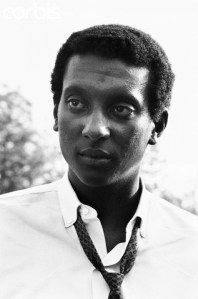
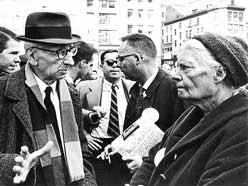 Seated just behind Carmichael is pacifist icon A.J. Muste, who had just returned from a visit to Vietnam (looking just as he did in the iconic photo with Dorothy Day, left). Then at the table itself sit Army privates Dennis Mora, James Johnson and Robert Samas, also known as the “Fort Hood Three,” announcing their intention to refuse deployment to Vietnam– flanked by Lincoln Lynch, of the Congress on Racial Equality, and the ubiquitous Staughton Lynd, co-chair with Muste of the Fort Hood Defense Committee.
 Image #2 was on the cover of WIN Magazine in January 1981. It’s from the November 1980
 Incredible Panic Rules