Category Archives: organizing

three quick taps again

More completely disparate bits, on the same principle as the last.

obamacolumbiaFirst —  Forget NYPIRG, President Obama was that same rare species as I – a 1980’s college peacenik! Luckily, the snarky press only recently hold of this earnest student article in a Columbia U magazine, whose eager framing of its subjects reminds me of my first tries at that kind of writing.

The issue’s dated March 1983, which empowers me to play that game of “where were you then?”  I had just started that internship I mentioned in that NYPIRG post, and probably had attended conferences of that Students Against Militarism group he mentions in the piece. I guess Barack had good reason to fly back to Chicago after NYPIRG. He was in danger of turning out liike me  — a writer with an obsession with war and peace, and thus few career prospects.

Second, my other shop has more on that peace village on the Green Line, as well as other news you can use.

And for your video portion, anyone who screamed when Bush denied neglect after Katrina should get a kick out of Campbell Brown ripping the still-president a new one:

the real happiest places on earth

Two quick notes so while I crash through my book deadline, one serious, one less so:

I have even less useful to say about Gaza than I had on Mumbai. So I’ll take refuge, as I often do, to the one spot of hope I know of in that part of the world. I remember visiting there in 1990, and I’m always comforted to know that they’re still doing the work – creating a new generation that can, maybe, figure the rest of the shit out. Turns out they’re also speaking out against the current insanity.

The video’s a bit long, but worth it:

If you haven’t put The Smoking Gun.com on your list of sources, you’re missing out. In addition to a full supply of investigative stuff — grand jury testimony, mug shots — It turns out to be the place to go if you want to know more than you thought was out there about the super-short military careers of …

Jack Kerouac, who stopped by in between terms at Columbia during World War II and was discharged as completely out of his mind;

and Jimi Hendrix — who gets discharged for, as TSG, playing too much on his instrument. (The Army charged him for the laundry bills, too!) Which gives me an excuse to put this up – I’d forgotten how amazing it is. Just watch it first, otherwise you’ll only look at his hands.

poetry is news that stays news

marchantRecently, I spend four hours transcribing an interview with this guy, who’d privileged me with two hours of his time.  The link tells you why he talked to me; below is why you should care.

I defy you not to get chllls, especially if you understand what his title refers to.

The Phoenix Program
by Fred Marchant

Afterwards, the children stood outside
the house of their birth
to witness how it too had to be punished.

When they came of age, they fled to the capital,
lost themselves in the study of history and great works of art,
graduated in swirling carmine robes.

Burdened with a knowledge that murderers
name their deeds after winged deities,
they dream for awhile of claws on the back,

but later they become certain there was
nothing they could have done.
And they are not alone.

It is like this throughout the city.
On each corner you can see them—
leaning as if the vanishing point on their horizon

were other than ours.
They speak quietly only to one another.
They play no instruments, and do not sing.

2008 was the REAL Year of the Woman

From my right-hand sis Elizabeth Willse, a New Year’s hail.

Among the menopausal mamas she hailed were some I’ve not yet noted here:

This week’s  Newsweek Magazine notes that Oprah Winfrey’s influence on the 2008 presidential campaign is still being debated: “She’s denied that Obama is giving her a job, but we know she already has his ear.”

The Audacity of Race: For many, the election of Barack Obama
“was more than a political victory, it was a personal victory.”  But,
as Mattie Francis observes, “We cannot pretend, as I heard some
morning-after political pundits say, that we are ‘a colorblind nation’
at this time in history.  This is a myth.”   Writing for the Point Reyes Light,
she uses her own interracial marriage and motherhood to examine the
questions of race and identity that will color politics, into the new
year and the new presidency.

If ever there is way for a white girl from the Midwest to comprehend not only intellectually but also
viscerally that race is a social construct with no biological basis, it is for her to give birth to a brown baby. Stephan Thernstrom, a professor of history at Harvard University, said that the United States is the only country in the world in which a white mother can give birth to a black child but a black mother cannot give birth to a white child.

Kolata
Sniffling on the Stairmaster?
A midwinter cold got you coughing
and sneezing?  Although doctors and exercise physiologists are mostly
“stumped” and don’t yet have the final word on exercising with a cold,
Gina Kolata of the New York Times points to studies showing it may be
time to sweat it out.  Instead of languishing on the couch, read about these two studies,
and maybe cinch up your sneakers instead.  One study revealed that having
a cold had no effect on lung function or exercise capacity.  The other
found that, even though exercisers and non-exercisers had symptoms for
the same length of time, those who exercised ‘in some cases, actually
felt better.’

If you’re going to exercise, though, take it easy
until you feel better.  The consensus from the studies seems to be
that, in most cases, exercise will help ease a cold where there’s no
fever or chest congestion.  And you’ll be back to full strength, and
full workouts, in no time.

Hoskins
Modern Love, Modern Healing
:
It was “déjà vu all over the X-ray screen.”  When Sally Hoskins,
neurobiologist and science educator, was diagnosed with breast cancer
for a second time, she thought she knew what to expect.  She planned to
go it alone, no support group.  She knew the drill.  She thought she
didn’t want the “instant support group” of the other women “all
first-timers” wearing hospital gowns and awaiting their treatments.  Accepting another woman’s offer of a Xanax breaks the ice for a conversation, and, much needed support, Hoskins admits. “Yes, I was buoyed in part by my Xanax-filled water wings. But what
really kept me afloat was the one thing I had mistakenly believed I
could do without: the loving care that flows freely among female
strangers even in short-term groups like this one, established within
minutes and disbanded just as quickly, only to re-form with a whole new cast in the next waiting room, and the next.”

Wingerbook
Debra Winger is digging in a little deeper
:
Debra Winger has taken time away from Hollywood to teach a course at
Harvard, have a baby, write a book, run a farm, and take a handful of
smaller film roles, well away from the public eye.  Now, she’s back, and being interviewed by Rachel Cooke about her small role in “Rachel Getting Married.”  Of the film, Cooke
says: “Rachel Getting Married has won Winger rave reviews – ‘devastating,’ ‘magnificent,’ ‘too long between films’ – for a part you could miss
completely should you succumb to a sudden urge for popcorn.”  Winger plans to keep a sense of perspective, and a strong activist voice as she returns to the screen:

You have to make a concerted effort to keep yourself alive, to be able
to feel pain, to stop yourself from getting distanced from things by
technology. Some 250,000 protestors walked up Broadway to protest the
war in Iraq, and the next day it wasn’t in the papers. But will that
stop me from marching next time? No, I will be counted.”

(Elizabeth W.)

If you’re mad about Rick Warren, get out tomorrow and light up the night.

I was going to try to write about  Rick Warren being  asked to give the inaugural invocation, which yesterday pulled me from my bookwriting stupor back into that November 5, no we can’t! fury. And as you see above, I wasn’t alone:

As Michelle Goldberg puts it so pleasantly in The Guardian: He is a man who compares legal abortion to the Holocaust and gay marriage to incest and paedophilia. He believes that Jews, Muslims, Buddhists, Hindus and other non-Christians are going to spend eternity burning in hell. He doesn’t believe in evolution. He recently the social gospelthe late 19th- and early 20th-century Protestant movement that led a religious crusade against poverty and inequalityas “Marxism in Christian clothing.

Or as Linda Hirshman noted on the WAM listserv (I’m posting this with her permission):

Rick Warren’s site for educating preachers, Pastor.com, has a long essay on why women should submit to their husbands. Here’s the money line: “The Greek word for ‘submit’ is hupotassoHupo means “under” and tasso means “to place in order.” The compound word hupotasso means “to place under or in an orderly fashion.” Paul didn’t dislike women, he liked order! He advocated order in the church, order in government, order in business, and, yes, order in the home.

Then I remembered what gave me hope after that, and decided I was better off pushing this event for tomorrow.

It’s not just a vigil and food drive: it’s us giving notice that Obama better mean what he said yesterday, that they’ll push for a quick repeal of DOMA and eliminatinn of DADT.  And we’ll press that case in Washington on January 10th, just before the inaugural. Just in case.

the WAC of my dreams

It’s a voice I hardly remember not having heard: the writer in the edgy science-fiction anthologies, the voice cool as ice, the material borderline radical. How many times did I read “The Girl Who was Plugged In” (turned later into an episode of Paradox), whose plaintive cyborg “Delphi” predated Blade Runner by decades?  Or the moment in “The Women Men Don’t See when the steely narrator tries to reassure a woman that she matters:

“Come on, why doomed? Didn’t they get that equal rights bill?”

Long hesitation. When she speaks again her voice is different.

“Women have no rights, Don, except what men allow us. Men are more aggressive and powerful, and they run the world. When the next real crisis upsets them, our so-called rights will vanish like—like that smoke. We’ll be back where we always were: property. And whatever has gone wrong will be blamed on our freedom, like the fall of Rome was. You’ll see.”

Now all this is delivered in a gray tone of total conviction. The last time I heard that tone, the speaker was explaining why he had to keep his file drawers full of dead pigeons.

“Oh, come on. You and your friends are the backbone of the system; if you quit, the country would come to a screeching halt before lunch.”

No answering smile.

“That’s fantasy.” Her voice is still quiet. “Women don’t work that way. We’re a—a toothless world.” She looks around as if she wanted to stop talking. “What women do is survive. We live by ones and twos in the chinks of your world-machine.”

“Sounds like a guerrilla operation.”

Frankly, I was never the HUGEST fan of James Tiptree, Jr, despite the Hugos and Nebulas and the knowledge that it was a pseudonym for a woman writer. I was kept at a distance by that detached voice, the same one that long convinced famous male writers like Robert Silverberg that the mysterious writer couldn’t be female, “for there is to me something ineluctably masculine about Tiptree’s writing.”  I’d never thought to buy the 2005 biography by Julie Phillips – I confess i didn’t even go to the extent of reading about it.

If I had, I’d have known that I’ve been looking for her for a long time.
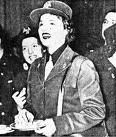
allidaveyNot that she hasn’t already been in front of my face. In the 1945 manifesto from the American Veterans Committee mentions a “Captain Alice B. Davey, WAC, Armed Forces Advisory Committee” on its list of leaders. But it wasn’t till that hissy fit last week that I started trying to track down if she were someone worth writing about. The answer of course, was more than yes: Major Alice Bradley Davey Sheldon, who her mom called “Alli,”  was more of a kindred spirit than I imagined.

I’d been looking for, as I said to friends, “a WAC vet with complex thoughts.” In Alli I also found a writer, a dreamer, a bisexual who described boot camp in her diary:

the long grey-green lines of women, for the first time in America, in the rain, under the flag, the sound of the band, far-off, close, then away again; the immortal fanny of our guide, leading on the right, moved and moving to the music—the flag again—first time I ever felt free enough to be proud of it; the band, our band, playing reveille that morning, with me on KP since 0430 hours, coming to the mess-hall porch to see it pass in the cold streets, under that flaming middle-western dawn; KP itself, and the conviction that one is going to die; the wild ducks flying over that day going to PT after a fifteen-mile drill, and me so moved I saluted them.

Of my characters from this war, she belongs more with John Huston, who withdrew to Mexico in 1980, than with Howard Zinn or William Kunstler or Philip Berrigan. Most of her stories only whispered their social critiques. But she lays it out pretty clearly in “The Women Men Don’t See,” a few exchanges after the one above:

“Men and women aren’t different species, Ruth. Women do everything men do.”

“Do they?” Our eyes meet, but she seems to be seeing ghosts between us in the rain. She mutters something that could be “My Lai” and looks away. “All the endless wars …” Her voice is a whisper. “All the huge authoritarian organizations for doing unreal things. Men live to struggle against each other; we’re just part of the battlefield. It’ll never change unless you change the whole world.”

Alli, you were half right. Thanks for your muscular telling of the paradoxes you saw.

(Many thanks to Julie Phillips, for working so closely to bring her to the world. If I can convey 1/10 of what you have, I’ll consider myself lucky.)

Diversity begins at home.

You’d think that someone who started out her interest in military-GI issues advocating for women in the military, working hand in hand with  the likes of Linda Grant de Pauw, Rep. Patricia Schroeder and  Captain Barb, who therefore knew about women in every war fought by the U.S, would have women as characters easily laced throughout the history I’m writing.

You’d think that a dyke who loved being able to give  Walt Whitman’s boyfriend voice in my Civil War chapter would be on the alert for the gays described by Allen Berube, who dissented in their very presence in World War II — and not have to had thown at me the compelling example of Guadalcanal vet Paul Moore, a running buddy of William Sloane Coffin. (Below is a clip of his daughter Honor, who wrote a book about his double life.)

And you might even think that a girl who is obsessed with Bayard Rustin and led her earlier chapters with dissenters of color —William Apess, Lewis Douglass, W.E.B. duBois— wouldn’t draft a chapter with a nearly all-white cast, with the exception of Medgar Evers. That a girl who squinted at and photocopied stuff from A. Philip Randolph’s Committee Against Jim Crow in the Armed Services would have naturally devoted a few lines to the NAACP’s 1942 “Conscientious Objectors Against Jim Crow.” That she’d at least have included 73-yr-old du Bois sighing that ‘ We fight for democracy not only for white folk but for yellow, brown, and black…We fight not in joy but in sorrow with no feeling of uplift.”

Nope: as currently drafted my World War II chapter, like the war itself, features an  all-male, nearly all-white cast. I slapped myself upside the head last night when I realized it. Better now than later, when Cynthia Enloe and Linda Bird Francke would do it more publicly on reading the final product.

To use the kind of language we used in the 1980s: I know I’m twisted by white privilege, but when did the frigging patriarchy decide to colonize my thinking?

Superman vs. the VFW?

In the department of stuff you come across while looking for something else, I found this radio show (the link brings on streaming audio). Click, and you can listen to a “thousands of GI’s” protesting “racial discrimination in state hiring,” and a kind of unusual ally has their backs: Superman, who flies in to stop the state troopers ordered to fire on the vets. Not unusual, it turns out, for the Superman radio show of 1940-1951, whose stories never appeared in comics and which also featured Superman vs. The Clan of the Fiery Cross (also known as the KKK).

This is all old news to true geeks, and doubtless other better writers than I, like  Michael Chabon. But I stumbled across it while poking around for something almost no one remembers (sort of my specialty): the American Veterans Committee.

AVC was a short-lived World War II veterans’ organization whose slogan was “Citizens First, Veterans Second.” And that story about the veterans protest was grounded in the same reality that gave AVC nearly a million members at its start.

By mid-1946, when that story ran,  literally 12,000 active-duty soldiers were busy protesting at bases around the world, accusing the Truman administrationof dragging its feet in getting them home. One famously told Truman, “Give us our independence or go home to yours!”  AVC, founded by the fellow below (who is not, as he seems, Orson Welles), had on its board civil rights icon Medgar Evers and Howard Zinn, among others. Many were writers, like Benjamin Bradlee and E.J. Kahn, and doubtless others found their way to that Superman show. In September of ’46, the AVC issued a special commendation to the producers of the show for its quiet linking of veterans with “social tolerance.”

bolteun

Actually, the VFW had issued a similar award the month before, though it was for promoting “the American way” – code for crushing “commie” stuff like those  “tolerant” Superman shows, which shut down in 1951 in favor of the commie-busting TV version.  No place in the new Cold War for such thoughts — or for a veterans group that saw itself as composed of angelic troublemakers (e.g.  sleeping in L.A. streets as a housing protest).  By the time the 1954  Senate Subcommittee Hearings on Juvenile Delinquency tamed Superman completely, the AVC had mostly collapsed under a not-unfamiliar perfect storm of personality clashes, sectarian-left noise (snooze) and McCarthyism. Leaving veterans of that war to choose between the American Legion and the VFW, as odious to them as to many OEF/OIF vets now.  Its founders basically did neither, choosing instead journalism, or film, or think tanks like the Carnegie Foundation for International Peace.

What happened next is still happening: some will be in the book. Stay tuned for some character sketches.

But I wonder if it would be too much of a cheat to lede my “necessary war” chapter with that fictional scene of “thousands of GIs.” (What do you think?)

100 million castaways, demanding a home

100 million: That’s how many people who felt as I did last week. Or at least as many as stood up yesterday to say: Not in our America.

Using the skills that were so essential to the election of the current president, a handful of kids-with-broadband organized the event in cities around the country. They used email, Facebook, Twitter, and Youtube to provide a single, coordinated answer to the question so many were asking: “What do I do now?”

In Philly, the weather complied, with 70-degree temps warming the crowd of 5,000 clustered by City Hall. A group as diverse as my new city, in both ethnic composition and age. Families with small children, parents,  ministers joined folks like myself and Rachel, or the guy with the sign “No More Mr. Nice Gay.” Or like white-haired Cass McGough, 72,  who eyes were a soft match to her carved earrings, and whose sign said simply: I’M TOO OLD FOR THIS SHIT. I didn’t ask her if she knew Harvey Milk, who would have been proud of the day.

“I never thought I’d live to see a black President,” McGough grinned as the crowd gathered. “But I also never thought they’d leave us so thoroughly out of this moment, either.”

Even more heartening, to me, was the Cataldi family — South Philly types who wouldn’t have looked out of place among my Bronx relatives. Dino Cataldi brought his entire family, whose signs were among those made famous on TV and here: A GAY MARRIAGE IS JUST AS IMPORTANT AS MY FIRST, SECOND AND THIRD STRAIGHT MARRIAGE. When I asked one of them why they’d come, he said “My brother-in-law!” and pointed to Dino, a burly guy with wavy hair and muscle-y arms.

Upon learning his last name, I told Cataldi about my own Italian family, and that my coming-out process felt at best incomplete. “You wanna know how I came out? My father asked me one night at dinner, Are you queer?  Before I could say anything, my brother answered for me: He’s not queer. He’s  gay.” In other words, not creepy, not other. For all my San Francisco-bred comfort with the term ‘queer,’ the story moved me, and I wished I could tell one just like it.

Meanwhile, the kids just kept coming. I felt like I’d seen them canvassing for Obama, and they’d just gone on to the next logical goal. They were passionate about not, as columnists did,  targeting not any demographic group, not even the Mormon Church — instead targeting the indifference of those to whom think gay and lesbian civil rights are a side issue, not worth showing up for.

Now, of course, comes the hard work of making even future protests share a goal. I’ll watch, and show up when I can. This could be the 21st-century ACT-UP, though so far we don’t have the artists to show for it.

(The video is from the 1981 Secret Policeman’s Other Ball, a benefit for Amnesty International. My title’s quote from The Police feels suddenly pretty on-topic.)