Category Archives: military

two pictures, old hope

Images  found this week at the Swarthmore College Peace Collection, now in dim photocopies.  I’ll scan both as soon as I can, and provide substitutes in the meantime:
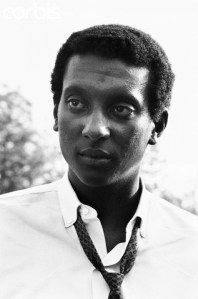
Stokely Carmichael in Alabama, 1966

Stokely Carmichael in Alabama, 1966

#1: June 30, 1966.  A room at NY Community Church on 35th Street, filled to bursting for a press conference. To the left of the table, a reedy and still-handsome David Dellinger, WWII conscientious objector and staff member at War Resisters League, and Stokely Carmichael, about to become chair of the Student Nonviolence Coordinating Committee (SNCC), looking almost exactly as he does at right.
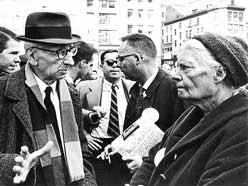
musteday1Seated just behind Carmichael is pacifist icon A.J. Muste, who had just returned from a visit to Vietnam (looking just as he did in the iconic photo with Dorothy Day, left). Then at the table itself sit Army privates Dennis Mora, James Johnson and Robert Samas, also known as the “Fort Hood Three,” announcing their intention to refuse deployment to Vietnam– flanked by Lincoln Lynch, of the Congress on Racial Equality, and the ubiquitous Staughton Lynd,  co-chair with Muste of the Fort Hood Defense Committee.

In some ways, it’s a picture of the anti-war movement before it fractured into a million little pieces. When the priests, the poets, the politicos and the pranksters who demarcated the movement had yet to manifest themselves, and most simply thought of it as an extension of the struggle for civil rights, three years after the March on Washington.  The letterhead of the Defense Committeee lists, as members and sponsors, such seemingly-disparate pairings a Dorothy Day and Noam Chomsky, both civil rights veteran leader Fred Halstead — soon to run for president on the Socialist Workers Party ballot — and the libertarian journo Nat Hentoff.

This was a moment  just before  Carmichael  went down to Alabama to organize the Lowndes County Freedom Party, whose symbol was a black panther, and long before he came to symbolize Black Power both to SNCC and the FBI;half a year before Muste died at 82, leaving behind a movement already beginning to shred; before the GI antiwar movement had multiplied, until there were imprisoned GIs, more “defense committees” charged with everything from conspiracy to murder, than anyone could count. It’s a serious photo, but somehow hopeful. No one in that room imagined that the war was in some ways just beginning; there’s none of the rage, exhaustion, Dadaist darkness  of even the Chicago Seven protests two years later.

wpaphotoImage #2 was on the cover of WIN Magazine in January 1981. It’s from the November 1980 Women’s Pentagon Action (left). But the image in front of me now is of two college sophomores, not yet nineteen years old, openly grieving after having marched to the Pentagon from Arlington National Cemetery. Ronald Reagan had just been elected, and the next war felt imminent. The crying was part of an innovative, emotionally structured sequence in which the demonstration went through stages, starting with grief and ending with defiance (civil disobedience). One of the girls in that photo is my heart-friend Julia Kay. And two rows behind those two is a girl in braids, looking forlorn and stubborn at the same time.

To my eye, none of those girls looks older than twelve — including the one in the braids. I was only four when those brave boys came forward at Fort Hood, and knew nothing of them when I wept at the Pentagon 15 years later.

Tomorrow is my birthday — god help me, I’ll be forty-seven. (No one told me when I celebrated 40 that it would keep going forward!) But working on this book has brought me closer to that girl in braids than I ever expected.
poetry friday a day early

cause that’s how it feels sometimes.


The Author to her Book

Thou ill-form'd offspring of my feeble brain,
Who after birth did'st by my side remain,
Till snatcht from thence by friends, less wise than true,
Who thee abroad expos'd to public view,
Made thee in rags, halting to th' press to trudge,
Where errors were not lessened (all may judge).
At thy return my blushing was not small,
My rambling brat (in print) should mother call.
I cast thee by as one unfit for light,
Thy Visage was so irksome in my sight,
Yet being mine own, at length affection would
Thy blemishes amend, if so I could.
I wash'd thy face, but more defects I saw,
And rubbing off a spot, still made a flaw.
I stretcht thy joints to make thee even feet,
Yet still thou run'st more hobbling than is meet.
In better dress to trim thee was my mind,
But nought save home-spun Cloth, i' th' house I find.
In this array, 'mongst Vulgars mayst thou roam.
In Critics' hands, beware thou dost not come,
And take thy way where yet thou art not known.
If for thy Father askt, say, thou hadst none;
And for thy Mother, she alas is poor,
Which caus'd her thus to send thee out of door.

six years on, we are all conscientious objectors

A month or so since I posted and I’m still speechless. More soon, I promise.
Meanwhile, there are all sorts of important things to say on the sixth anniversary of the invasion of Iraq, but for now I think I’ll just let a poet say it, again. In 2003 I quoted Yeats, but now let’s let Edna say it. (Above is one of the guys whose story is still trapping mine. Like LBJ, I seem to be unable to get out of that war.)

Conscientious Objector

I shall die, but that is all that I shall do for Death.

I hear him leading his horse out of the stall;
I hear the clatter on the barn-floor.
He is in haste; he has business in Cuba,
business in the Balkans, many calls to make this morning.
But I will not hold the bridle
while he clinches the girth.
And he may mount by himself:
I will not give him a leg up.

Though he flick my shoulders with his whip,
I will not tell him which way the fox ran.
With his hoof on my breast, I will not tell him where
the black boy hides in the swamp.
I shall die, but that is all that I shall do for Death;
I am not on his pay-roll.

I will not tell him the whereabout of my friends
nor of my enemies either.
Though he promise me much,
I will not map him the route to any man’s door.
Am I a spy in the land of the living,
that I should deliver men to Death?
Brother, the password and the plans of our city
are safe with me; never through me Shall you be overcome.

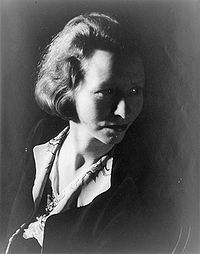
Edna St. Vincent Millayedna_st_vincent_millay

call it love or call it reason

More flotsam from my life-on-Mars phase:

I didn’t know this video existed, until now. I wish I had a clip of Ochs’ performance at the first Winter Soldier (two years later than this TV appearance) but this is good enough  for now. Knowing that the vets in Detroit heard Ochs’ anthem, just before four days of hearings on war crimes, makes me feel more certain than ever that I chose the right title for the book.

can you hear me major tom?

So I’ve been of late calling myself “Billy Pilgrim,” when people ask me how I am; digging tenaciously through those mad years we call “the Vietnam era,” which I subtitle as “When Everything Blew Up and Everything Grew.” What, she’s not done yet? Not yet, not when I spent thompsonnearly three weeks with the likes of Hugh Thompson (left) Ron Ridenhour (right) ron5 and the ubiquitous Tod Ensign,  as well a the guy below (hidden three rows behind Jane Fonda) who hasn’t yet talked to me about what I still think of as his proudest hour. (Also buds like Steve Morse, Bill Perry, and Susan Schnall, who’ve given me so much of their time…)  The whole thing makes me weirder than usual. I’m boring to be around: scattered, listening constantly to Hanoi Hannah on Pandora.com to get in the mood, etc. etc.
kerryfonda1

But this week, I realized that Vonnegut is far too noble an antecedent to call on here: better that  TV show “Life on Mars,” (thus the David Bowie above). So now, when people ask me “How’s the book??” I won’t say I’m Billy Pilgrim. This week, at least, I’m Sam Tyler – a 21st-century creature who keeps thinking they’ve moved on, only to be dragged right back to 1973, one more time.

my only valentine’s day poem

cummingsI loved this poem long before the author became one of my book’s guys (“i sing of olaf,” The Enormous Room et al.). I once asked my students, as their midterm, to explain to me how someone can write a love poem without ever using the word. Can you tell me?

somewhere i have never travelled, gladly beyond
any experience,your eyes have their silence:
in your most frail gesture are things which enclose me,
or which i cannot touch because they are too near

your slightest look will easily unclose me
though i have closed myself as fingers,
you open always petal by petal myself as Spring opens
(touching skilfully,mysteriously)her first rose

or if your wish be to close me, i and
my life will shut very beautifully ,suddenly,
as when the heart of this flower imagines
the snow carefully everywhere descending;
nothing which we are to perceive in this world equals
the power of your intense fragility:whose texture
compels me with the color of its countries,
rendering death and forever with each breathing

(i do not know what it is about you that closes
and opens;only something in me understands
the voice of your eyes is deeper than all roses)
nobody,not even the rain,has such small hands

studying with truman

Sometimes things happen in the right order. If I had been a conscientious student at Hunter High School, I’d have read this book under Jack McNeil, my very first Creative Writing instructor. At the very least, you might think I’d have taken it 20 years later, as a narrative-obsessed journalist. But the true-crime genre it spawned had persuaded me I didn’t need to; who needed to read about a grisly murder? I care about trauma, but didn’t I already admire, and praise in my teaching,  My Dark Places, James Ellroy’s account of the murder of his mother and his search for their killer? And I certainly never saw the 1976 film made from the book.

Even seeing the two recent “Capote movies” back to back didn’t drive me to the book. The more famous of the two, Capote, was most interesting for its portrayal of Capote’s erotic attachment to accused killer Perry Smith (played above by Robert Blake in the 1967 flick). And seeing Infamous (trailer below) I was taken by Capote’s close partnership with Harper Lee, who did a lot of the reporting Capote ultimately claimed was his own.

It wasn’t till I came across the book here in Philadelphia that I decided it was time to read it — that would be a good lesson in the writing of narrative nonfiction. Now, I’m kind of stunned.

Six years it took for Capote to combine it all — to dream the dream properly till it was, as my old sensei John Gardner  demands of fiction, both vivid and continuous. And I’m thankful that I went in with *exactly* the amount of information I had.  I was simultaneously swept up in the dream and, on every page, nodding admiringly at how the story of that Kansas morning was woven from soft conversations with farm folk and stubborn cops.

I sit here persuaded of two things:

  1. That the story it tells is both profound and rather slight, as I’d long suspected.
  2. That I have to find the scholars who’ve looked at Capote’s summary of the psychiatric testimony, and see those psychiatrists ooked at Smith’s military experiences in detail.
  3. That as long as I live as a writer, I can study all I like, but it’s unlikely that I’ll ever write any prose that comes ten percent within Capote’s.

None of which stops me from writing: and it’s dourly appropriate to read this as I construct snapshots from the tales told by veterans.  I’ll just hope that some of the fairy dust clings to my fingers, so that the ten percent range is still achievable.

hanoi hannah in philadelphia

Still CRAZY deadlined. Spent much of the weekend in 1968, when — as Nancy Zaroulis and Gerald Sullivan put it in their 1984 Who Spoke Up?: American Protest Against the War in Vietnam — “events happened so quickly, hammer blow after hammer blow, that in retrospect it seems astonishing that the national psyche survived intact. Perhaps it did not. ”  I didn’t even make it to the NYC re-release of the film above, though I’m being told about it by enough others who were there when it was first filmed. I’ll write more about them later, but in the meantime, here’s a glimpse of why I started my journey into this book in the first place. (Hanoi Hannah is a Pandora radio station that I didn’t start, but is giving me a soundtrack right now).

when elephants walk

Last time I posted a poem by this guy it was after having heard his voice for the first time in a while. Below, now, is the moment when, instead of traveling on a poetry fellowship, he shipped out for Vietnam. I’m not sure it’s the best way to start writing about that fact, but it seems only fair to him to keep his work shimmering in the back and front of my mind.

Elephants Walking

I.

Curled in a window seat, level with wind-swayed oak,

aching on a green vinyl pad,

I think of the fortunes spent on the hardwood, wainscot

study, and the slates fitted

for the arbor walkways, the labor it took to lug bricks out

to each overly articulated

corner, in which nook a child of fortune, cushion- tassel

between his fingers, might

look up from his reading to see in heat waves rising

over the pale, shimmering

delphinium, a plot miracle perhaps, the sudden death

by spontaneous combustion

and the child wondering how, why, and could it have been?

II.

My childhood bedroom, summer night, one hand marking

the book, the others palm

and fingers printing moist, disappearing shadows on the wall.

brownuniversity-harknesshouseThen the college library,

Harkness Hall, and aged, white-cowled Father Benilde

smelling of coffee, muscatel,

and Old Spice as he opened the doors at 7:30. First in line

I was all business, heading

straight to my end of a long, immovable table, to my first

reading of Dante, a paperback

infernociardicopy of Ciardi, with its cover of red, grinning, cartoon

Devils, which I in a fit

of verisimilitude (which word I had just learned)

add chard with a lighter.

III

My first lines that year: “Butt, butt, bale beast.

I fear your horns not

in the least! My intended tone was courtly love

but the words were

apostrophe to a buffalo in Roger Williams Park,

one that had leaned

hard into a sagging hurricane fence near my date.

The lines came to me

as I woke after a nap in the library. I still love

to sleep in libraries

whenever I can. I fix my head sideways over

my folded hands

and make room for the little puddle of drool

I’ll quickly wipe away.

I wake into a barely believable clarity

throughout my body.

I’m ready to grapple with fate, love, sex,

the stirrings within.

Over readers and sleepers alike hovers a mist

or a pollen, and in it

I see words shuttling back and forth like birds.

In the darkness or dream

something hugely important had been freed,

to roam. Grateful,

I say to myself, “Elephants have been walking.”

IV.

“Son, we must give this country great poetry!”

decreed the older poet

to my nodding head, as he shook my hand after

the Crystal Room reading.

Later, as I walked back to my dormitory, sleet

failed to cool me,

I turned his pronoun over and over, thinking,

yes, we do, we do.

On the news there was familiar footage:

a Phantom run

ending in a hypnotic burst of a lift yellow napalm.

I knew the war

was wrong, but that was why, I claimed, I should go,

to sing the song

of high lament, to get it into the books. Like Ishmael

I would sign on

for a three-year voyage under a madman captain.

Frissons to be had

instantly, a pity-the-youth-soon-dying look in the eyes.

“Are you crazy?”

said my girlfriend. But I was filled with vibrant life

and felt neither suicidal

nor confused when I dialed the Marine recruiter: “Yes,

I look forward to reporting.”

Phone in my lap, I sat sideways, my legs dangling

over the arms of my red

leather reading chair. A warm spring wind was

melting the snow

down to bright medallions of ice. I felt clear-headed

and refreshed.

I just hoped the war would last until I got there.

Elephants were walking.

I do think I forgot the crucial question of the interview, after Marchant quoted this poem. As he packed for boot camp, did he bring a moleskin notebook? And in his heart was he following Homer, Hemingway or just Randall Jarrell?

because yesterday, inauguration commenters all said…

That there’s “consensus” about the wars we’re mired in:

p.s. Part of me is still holding onto yesterday’s glow, at least a little – and bemused by what ended up in the liveblog I was running all day: earnest joy, snark, sly memories, and thanks to Julia, an endorsement from a bobcat.