Category Archives: journalism

By the way, for those who tweet

tweety1I can’t decide whether Twitter is an exercise in mass haiku, an ADD enabler, a time sink or all of the above. I’m therefore not doing a widget with this. But if you tweet, consider following Chris411 and I’ll reciprocate. (Though if I know you, you’re too busy following Brent Spiner or Rachel Maddow.)

Update: Apparently, via this site you can also follow Lincoln’s and other tweets-throughout-history. I’m sort of terrified to look there for James Joyce or Joan of Arc.

because yesterday, inauguration commenters all said…

That there’s “consensus” about the wars we’re mired in:

p.s. Part of me is still holding onto yesterday’s glow, at least a little – and bemused by what ended up in the liveblog I was running all day: earnest joy, snark, sly memories, and thanks to Julia, an endorsement from a bobcat.

MLK: words immortal, work unfinished

For many, probably most, people today’s observance is also a cry of joy about the possibilities represented by (say it!) President Barack Obama. But I personally hope our new president listens to *this* MLK speech tonight somewhere, and maybe puts a podcast of it on his iPod or something. The words still hold, until big changes are made. (Video via SF channel kensonofkevin.)

Not to be all late-boomer about it, but I’ve had the line “Iraq=Korea/ Afghanistan=Vietnam” flash through my mind a lot lately. The first war prosecuted by an amiable fool, the second by the “best and brightest.” Put it on my list of Bumper Stickers I Don’t Want to See.

call me “minor but influential?”

My journalistic ouevre is not as deep as most. But for ha-has, I did an ego search on Google Books, and found myself cited in more books than I expected (and quoted,too). I irrationally went, “Woot!” I’m also deeply curious what piece of mine falls under “restricted’ content.

Now I have to go back to getting my *own* book to join them there.

The Rule of Law in an American War

Military Justice in Vietnam: The Rule of Law in an American War‎ – Page 209

by William Thomas Allison

See also Chris Lombardi,”The Military Extraterritorial Jurisdiction Act of
2000: Implications for Contractor Personnel,” ….

Media Perspectives on Sexuality, Gender, and Identity

Sexual Rhetoric: Media Perspectives on Sexuality, Gender, and Identity‎ – Page 45

by Meta G. Carstarphen, Susan C. Zavoina – Social Science – 1999 – 304 pages

Chris Lombardi, spokeswoman for a group of former servicewomen who say they … top training official as saying possible remedies for the military’s sex …

Militarism and Blowback in the Era of American Empire

Masters of War: Militarism and Blowback in the Era of American Empire‎ – Page 308

by Carl Boggs, Ted (FRW) Rall – Political Science – 2003 – 371 pages

Military…Chris Lombardi, Women’s Enews …

An Evaluation Guide

Child Maltreatment Risk Assessments: An Evaluation Guide‎ – Page 217

by Sue Righthand, Bruce Kerr, Kerry Drach – Social Science – 2003 – 216 pages

…that only decisive action by military leadership at all levels can break the
cycle …Chris Lombardi, Correspondent. Women ‘s E-News, New York City THE

Neurologically Based ...

Psychological Trauma and the Developing Brain: Neurologically Based …

by Phyllis T. Stien, Joshua C. Kendall – Psychology – 2003 – 270 pages

[ Sorry, this page’s content is restricted ]

Strategies for ...

Simple and Complex Post-traumatic Stress Disorder: Strategies for …

by Mary Beth Williams, John F. Sommer – Medical – 2002 – 408 pages

[ Sorry, this page’s content is restricted ]

Politics and Public Policy with Research Navigator

Social Welfare: Politics and Public Policy with Research Navigator

by Diana M. DiNitto, Linda K. Cummins – Political Science – 2006 – 562 pages

[ Sorry, this page’s content is restricted ]

A Guide for Helping Trauma-exposed Children and ...

three quick taps again

More completely disparate bits, on the same principle as the last.

obamacolumbiaFirst —  Forget NYPIRG, President Obama was that same rare species as I – a 1980’s college peacenik! Luckily, the snarky press only recently hold of this earnest student article in a Columbia U magazine, whose eager framing of its subjects reminds me of my first tries at that kind of writing.

The issue’s dated March 1983, which empowers me to play that game of “where were you then?”  I had just started that internship I mentioned in that NYPIRG post, and probably had attended conferences of that Students Against Militarism group he mentions in the piece. I guess Barack had good reason to fly back to Chicago after NYPIRG. He was in danger of turning out liike me  — a writer with an obsession with war and peace, and thus few career prospects.

Second, my other shop has more on that peace village on the Green Line, as well as other news you can use.

And for your video portion, anyone who screamed when Bush denied neglect after Katrina should get a kick out of Campbell Brown ripping the still-president a new one:

the real happiest places on earth

Two quick notes so while I crash through my book deadline, one serious, one less so:

I have even less useful to say about Gaza than I had on Mumbai. So I’ll take refuge, as I often do, to the one spot of hope I know of in that part of the world. I remember visiting there in 1990, and I’m always comforted to know that they’re still doing the work – creating a new generation that can, maybe, figure the rest of the shit out. Turns out they’re also speaking out against the current insanity.

The video’s a bit long, but worth it:

If you haven’t put The Smoking Gun.com on your list of sources, you’re missing out. In addition to a full supply of investigative stuff — grand jury testimony, mug shots — It turns out to be the place to go if you want to know more than you thought was out there about the super-short military careers of …

Jack Kerouac, who stopped by in between terms at Columbia during World War II and was discharged as completely out of his mind;

and Jimi Hendrix — who gets discharged for, as TSG, playing too much on his instrument. (The Army charged him for the laundry bills, too!) Which gives me an excuse to put this up – I’d forgotten how amazing it is. Just watch it first, otherwise you’ll only look at his hands.

poetry is news that stays news

marchantRecently, I spend four hours transcribing an interview with this guy, who’d privileged me with two hours of his time.  The link tells you why he talked to me; below is why you should care.

I defy you not to get chllls, especially if you understand what his title refers to.

The Phoenix Program
by Fred Marchant

Afterwards, the children stood outside
the house of their birth
to witness how it too had to be punished.

When they came of age, they fled to the capital,
lost themselves in the study of history and great works of art,
graduated in swirling carmine robes.

Burdened with a knowledge that murderers
name their deeds after winged deities,
they dream for awhile of claws on the back,

but later they become certain there was
nothing they could have done.
And they are not alone.

It is like this throughout the city.
On each corner you can see them—
leaning as if the vanishing point on their horizon

were other than ours.
They speak quietly only to one another.
They play no instruments, and do not sing.

2008 was the REAL Year of the Woman

From my right-hand sis Elizabeth Willse, a New Year’s hail.

Among the menopausal mamas she hailed were some I’ve not yet noted here:

This week’s  Newsweek Magazine notes that Oprah Winfrey’s influence on the 2008 presidential campaign is still being debated: “She’s denied that Obama is giving her a job, but we know she already has his ear.”

The Audacity of Race: For many, the election of Barack Obama
“was more than a political victory, it was a personal victory.”  But,
as Mattie Francis observes, “We cannot pretend, as I heard some
morning-after political pundits say, that we are ‘a colorblind nation’
at this time in history.  This is a myth.”   Writing for the Point Reyes Light,
she uses her own interracial marriage and motherhood to examine the
questions of race and identity that will color politics, into the new
year and the new presidency.

If ever there is way for a white girl from the Midwest to comprehend not only intellectually but also
viscerally that race is a social construct with no biological basis, it is for her to give birth to a brown baby. Stephan Thernstrom, a professor of history at Harvard University, said that the United States is the only country in the world in which a white mother can give birth to a black child but a black mother cannot give birth to a white child.

Kolata
Sniffling on the Stairmaster?
A midwinter cold got you coughing
and sneezing?  Although doctors and exercise physiologists are mostly
“stumped” and don’t yet have the final word on exercising with a cold,
Gina Kolata of the New York Times points to studies showing it may be
time to sweat it out.  Instead of languishing on the couch, read about these two studies,
and maybe cinch up your sneakers instead.  One study revealed that having
a cold had no effect on lung function or exercise capacity.  The other
found that, even though exercisers and non-exercisers had symptoms for
the same length of time, those who exercised ‘in some cases, actually
felt better.’

If you’re going to exercise, though, take it easy
until you feel better.  The consensus from the studies seems to be
that, in most cases, exercise will help ease a cold where there’s no
fever or chest congestion.  And you’ll be back to full strength, and
full workouts, in no time.

Hoskins
Modern Love, Modern Healing
:
It was “déjà vu all over the X-ray screen.”  When Sally Hoskins,
neurobiologist and science educator, was diagnosed with breast cancer
for a second time, she thought she knew what to expect.  She planned to
go it alone, no support group.  She knew the drill.  She thought she
didn’t want the “instant support group” of the other women “all
first-timers” wearing hospital gowns and awaiting their treatments.  Accepting another woman’s offer of a Xanax breaks the ice for a conversation, and, much needed support, Hoskins admits. “Yes, I was buoyed in part by my Xanax-filled water wings. But what
really kept me afloat was the one thing I had mistakenly believed I
could do without: the loving care that flows freely among female
strangers even in short-term groups like this one, established within
minutes and disbanded just as quickly, only to re-form with a whole new cast in the next waiting room, and the next.”

Wingerbook
Debra Winger is digging in a little deeper
:
Debra Winger has taken time away from Hollywood to teach a course at
Harvard, have a baby, write a book, run a farm, and take a handful of
smaller film roles, well away from the public eye.  Now, she’s back, and being interviewed by Rachel Cooke about her small role in “Rachel Getting Married.”  Of the film, Cooke
says: “Rachel Getting Married has won Winger rave reviews – ‘devastating,’ ‘magnificent,’ ‘too long between films’ – for a part you could miss
completely should you succumb to a sudden urge for popcorn.”  Winger plans to keep a sense of perspective, and a strong activist voice as she returns to the screen:

You have to make a concerted effort to keep yourself alive, to be able
to feel pain, to stop yourself from getting distanced from things by
technology. Some 250,000 protestors walked up Broadway to protest the
war in Iraq, and the next day it wasn’t in the papers. But will that
stop me from marching next time? No, I will be counted.”

(Elizabeth W.)

There sat down, once, a cold war on america’s heart

I didn’t know the video above existed, of my not-so-secret sensei JB.*, so excuse me while I catch my breath. I’ll wait, too. while you catch yours; here’s the heartrending poem he’s declaiming in that Irish-Woody-Allen accent. But that’s not the John Berryman poem I’m thinking about today.

I’ve never been a fan of Dream Song 23, below For the most part, Berryman at his best stayed away from explicit political references. But I’m staring at the Song now for clues, as I try in what I’m writing to evoke for 30 seconds an era I never lived through — wishing I’d never lost that great book The Dark Ages,  assigned by my beyond-brilliant Binghamton prof Sarah Elbert.

I also know that  I’m relying far too much on the Bayard Rustin phrase that David McReynolds taught me: Bayard spoke, he said,  about the era’s rigidity as “a large piece of sheet steel, 50 feet wide and 50 feet tall, and one inch thick – and if you  hit that with a  hammer at one corner, the entire sheet would reverberate.” (The Dark Ages referenced chronicles how under that steel, subversive elements like jazz and the Beats were gathering, though it makes almost no reference to any of my soldiers.)

jarrell_randallGrasping at cultural straws of all kind, I thought I’d try again. After all, Berryman was friends with WWII veteran Randall Jarrell (right) and in 1946 was teaching at Princeton, which like Yale had a front-row seat on the rest of my WWII story.

I know Berryman was spun by Hiroshima, and get the easy Joe Stalin bit, but what else is inside?   Please comment on what you see?  (You don’t have to be a Cold War baby to speculate.) I do think that the first verse, with its intimation of old-style TV static, comes closest to Rustin’s sheet of steel.

This is the lay of Ike.
Here’s to the glory of the Grewt White—awk—
who has been running—er—er—things in recent—ech—
in the United—If your screen is black,
ladies & gentlemen, we—I like—
at the Point he was already terrific—sick

to a second term, having done no wrong—
no right—no — right—having let the Army—bang—
defend itself from Joe, let venom’ Strauss
bile Oppenheimer out of use—use Robb,
who’ll later fend for Goldfine—Breaking no laws,
he lay in the White House—sob!!—

who never understood his own strategy—whee—
so Monty’s memoirs—nor any strategy,
wanting the ball bulled thro’ all parts of the line
at once—proving, by his refusal to take Berlin,
he misread even Clauswitz—wide empty grin
that never lost a vote (O Adlai mine).

Michael Erard of the Texas Observer had some thoughts about it last year – apparently Ike was about as articulate as Shrub, and he compares all the line-breaking to Ike’s speech.   I think Erard doesn’t recognize the purity of JB’s self-created syntax, though his comparison to the great “Mr. Bones” sections is probably apt. Still, what is the poem saying about that sheet of steel and who it silenced? Or should I be looking to the far-greater Dream Song 10 (Ike is 15) for my answer? However things hurt, men hurt worse.

Continue reading

the WAC of my dreams

It’s a voice I hardly remember not having heard: the writer in the edgy science-fiction anthologies, the voice cool as ice, the material borderline radical. How many times did I read “The Girl Who was Plugged In” (turned later into an episode of Paradox), whose plaintive cyborg “Delphi” predated Blade Runner by decades?  Or the moment in “The Women Men Don’t See when the steely narrator tries to reassure a woman that she matters:

“Come on, why doomed? Didn’t they get that equal rights bill?”

Long hesitation. When she speaks again her voice is different.

“Women have no rights, Don, except what men allow us. Men are more aggressive and powerful, and they run the world. When the next real crisis upsets them, our so-called rights will vanish like—like that smoke. We’ll be back where we always were: property. And whatever has gone wrong will be blamed on our freedom, like the fall of Rome was. You’ll see.”

Now all this is delivered in a gray tone of total conviction. The last time I heard that tone, the speaker was explaining why he had to keep his file drawers full of dead pigeons.

“Oh, come on. You and your friends are the backbone of the system; if you quit, the country would come to a screeching halt before lunch.”

No answering smile.

“That’s fantasy.” Her voice is still quiet. “Women don’t work that way. We’re a—a toothless world.” She looks around as if she wanted to stop talking. “What women do is survive. We live by ones and twos in the chinks of your world-machine.”

“Sounds like a guerrilla operation.”

Frankly, I was never the HUGEST fan of James Tiptree, Jr, despite the Hugos and Nebulas and the knowledge that it was a pseudonym for a woman writer. I was kept at a distance by that detached voice, the same one that long convinced famous male writers like Robert Silverberg that the mysterious writer couldn’t be female, “for there is to me something ineluctably masculine about Tiptree’s writing.”  I’d never thought to buy the 2005 biography by Julie Phillips – I confess i didn’t even go to the extent of reading about it.

If I had, I’d have known that I’ve been looking for her for a long time.
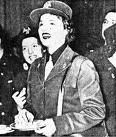
allidaveyNot that she hasn’t already been in front of my face. In the 1945 manifesto from the American Veterans Committee mentions a “Captain Alice B. Davey, WAC, Armed Forces Advisory Committee” on its list of leaders. But it wasn’t till that hissy fit last week that I started trying to track down if she were someone worth writing about. The answer of course, was more than yes: Major Alice Bradley Davey Sheldon, who her mom called “Alli,”  was more of a kindred spirit than I imagined.

I’d been looking for, as I said to friends, “a WAC vet with complex thoughts.” In Alli I also found a writer, a dreamer, a bisexual who described boot camp in her diary:

the long grey-green lines of women, for the first time in America, in the rain, under the flag, the sound of the band, far-off, close, then away again; the immortal fanny of our guide, leading on the right, moved and moving to the music—the flag again—first time I ever felt free enough to be proud of it; the band, our band, playing reveille that morning, with me on KP since 0430 hours, coming to the mess-hall porch to see it pass in the cold streets, under that flaming middle-western dawn; KP itself, and the conviction that one is going to die; the wild ducks flying over that day going to PT after a fifteen-mile drill, and me so moved I saluted them.

Of my characters from this war, she belongs more with John Huston, who withdrew to Mexico in 1980, than with Howard Zinn or William Kunstler or Philip Berrigan. Most of her stories only whispered their social critiques. But she lays it out pretty clearly in “The Women Men Don’t See,” a few exchanges after the one above:

“Men and women aren’t different species, Ruth. Women do everything men do.”

“Do they?” Our eyes meet, but she seems to be seeing ghosts between us in the rain. She mutters something that could be “My Lai” and looks away. “All the endless wars …” Her voice is a whisper. “All the huge authoritarian organizations for doing unreal things. Men live to struggle against each other; we’re just part of the battlefield. It’ll never change unless you change the whole world.”

Alli, you were half right. Thanks for your muscular telling of the paradoxes you saw.

(Many thanks to Julie Phillips, for working so closely to bring her to the world. If I can convey 1/10 of what you have, I’ll consider myself lucky.)