Category Archives: veterans

call me “minor but influential?”

My journalistic ouevre is not as deep as most. But for ha-has, I did an ego search on Google Books, and found myself cited in more books than I expected (and quoted,too). I irrationally went, “Woot!” I’m also deeply curious what piece of mine falls under “restricted’ content.

Now I have to go back to getting my *own* book to join them there.

The Rule of Law in an American War

Military Justice in Vietnam: The Rule of Law in an American War‎ – Page 209

by William Thomas Allison

See also Chris Lombardi,”The Military Extraterritorial Jurisdiction Act of
2000: Implications for Contractor Personnel,” ….

Media Perspectives on Sexuality, Gender, and Identity

Sexual Rhetoric: Media Perspectives on Sexuality, Gender, and Identity‎ – Page 45

by Meta G. Carstarphen, Susan C. Zavoina – Social Science – 1999 – 304 pages

Chris Lombardi, spokeswoman for a group of former servicewomen who say they … top training official as saying possible remedies for the military’s sex …

Militarism and Blowback in the Era of American Empire

Masters of War: Militarism and Blowback in the Era of American Empire‎ – Page 308

by Carl Boggs, Ted (FRW) Rall – Political Science – 2003 – 371 pages

Military…Chris Lombardi, Women’s Enews …

An Evaluation Guide

Child Maltreatment Risk Assessments: An Evaluation Guide‎ – Page 217

by Sue Righthand, Bruce Kerr, Kerry Drach – Social Science – 2003 – 216 pages

…that only decisive action by military leadership at all levels can break the
cycle …Chris Lombardi, Correspondent. Women ‘s E-News, New York City THE

Neurologically Based ...

Psychological Trauma and the Developing Brain: Neurologically Based …

by Phyllis T. Stien, Joshua C. Kendall – Psychology – 2003 – 270 pages

[ Sorry, this page’s content is restricted ]

Strategies for ...

Simple and Complex Post-traumatic Stress Disorder: Strategies for …

by Mary Beth Williams, John F. Sommer – Medical – 2002 – 408 pages

[ Sorry, this page’s content is restricted ]

Politics and Public Policy with Research Navigator

Social Welfare: Politics and Public Policy with Research Navigator

by Diana M. DiNitto, Linda K. Cummins – Political Science – 2006 – 562 pages

[ Sorry, this page’s content is restricted ]

A Guide for Helping Trauma-exposed Children and ...

the real happiest places on earth

Two quick notes so while I crash through my book deadline, one serious, one less so:

I have even less useful to say about Gaza than I had on Mumbai. So I’ll take refuge, as I often do, to the one spot of hope I know of in that part of the world. I remember visiting there in 1990, and I’m always comforted to know that they’re still doing the work – creating a new generation that can, maybe, figure the rest of the shit out. Turns out they’re also speaking out against the current insanity.

The video’s a bit long, but worth it:

If you haven’t put The Smoking Gun.com on your list of sources, you’re missing out. In addition to a full supply of investigative stuff — grand jury testimony, mug shots — It turns out to be the place to go if you want to know more than you thought was out there about the super-short military careers of …

Jack Kerouac, who stopped by in between terms at Columbia during World War II and was discharged as completely out of his mind;

and Jimi Hendrix — who gets discharged for, as TSG, playing too much on his instrument. (The Army charged him for the laundry bills, too!) Which gives me an excuse to put this up – I’d forgotten how amazing it is. Just watch it first, otherwise you’ll only look at his hands.

poetry is news that stays news

marchantRecently, I spend four hours transcribing an interview with this guy, who’d privileged me with two hours of his time.  The link tells you why he talked to me; below is why you should care.

I defy you not to get chllls, especially if you understand what his title refers to.

The Phoenix Program
by Fred Marchant

Afterwards, the children stood outside
the house of their birth
to witness how it too had to be punished.

When they came of age, they fled to the capital,
lost themselves in the study of history and great works of art,
graduated in swirling carmine robes.

Burdened with a knowledge that murderers
name their deeds after winged deities,
they dream for awhile of claws on the back,

but later they become certain there was
nothing they could have done.
And they are not alone.

It is like this throughout the city.
On each corner you can see them—
leaning as if the vanishing point on their horizon

were other than ours.
They speak quietly only to one another.
They play no instruments, and do not sing.

There sat down, once, a cold war on america’s heart

I didn’t know the video above existed, of my not-so-secret sensei JB.*, so excuse me while I catch my breath. I’ll wait, too. while you catch yours; here’s the heartrending poem he’s declaiming in that Irish-Woody-Allen accent. But that’s not the John Berryman poem I’m thinking about today.

I’ve never been a fan of Dream Song 23, below For the most part, Berryman at his best stayed away from explicit political references. But I’m staring at the Song now for clues, as I try in what I’m writing to evoke for 30 seconds an era I never lived through — wishing I’d never lost that great book The Dark Ages,  assigned by my beyond-brilliant Binghamton prof Sarah Elbert.

I also know that  I’m relying far too much on the Bayard Rustin phrase that David McReynolds taught me: Bayard spoke, he said,  about the era’s rigidity as “a large piece of sheet steel, 50 feet wide and 50 feet tall, and one inch thick – and if you  hit that with a  hammer at one corner, the entire sheet would reverberate.” (The Dark Ages referenced chronicles how under that steel, subversive elements like jazz and the Beats were gathering, though it makes almost no reference to any of my soldiers.)

jarrell_randallGrasping at cultural straws of all kind, I thought I’d try again. After all, Berryman was friends with WWII veteran Randall Jarrell (right) and in 1946 was teaching at Princeton, which like Yale had a front-row seat on the rest of my WWII story.

I know Berryman was spun by Hiroshima, and get the easy Joe Stalin bit, but what else is inside?   Please comment on what you see?  (You don’t have to be a Cold War baby to speculate.) I do think that the first verse, with its intimation of old-style TV static, comes closest to Rustin’s sheet of steel.

This is the lay of Ike.
Here’s to the glory of the Grewt White—awk—
who has been running—er—er—things in recent—ech—
in the United—If your screen is black,
ladies & gentlemen, we—I like—
at the Point he was already terrific—sick

to a second term, having done no wrong—
no right—no — right—having let the Army—bang—
defend itself from Joe, let venom’ Strauss
bile Oppenheimer out of use—use Robb,
who’ll later fend for Goldfine—Breaking no laws,
he lay in the White House—sob!!—

who never understood his own strategy—whee—
so Monty’s memoirs—nor any strategy,
wanting the ball bulled thro’ all parts of the line
at once—proving, by his refusal to take Berlin,
he misread even Clauswitz—wide empty grin
that never lost a vote (O Adlai mine).

Michael Erard of the Texas Observer had some thoughts about it last year – apparently Ike was about as articulate as Shrub, and he compares all the line-breaking to Ike’s speech.   I think Erard doesn’t recognize the purity of JB’s self-created syntax, though his comparison to the great “Mr. Bones” sections is probably apt. Still, what is the poem saying about that sheet of steel and who it silenced? Or should I be looking to the far-greater Dream Song 10 (Ike is 15) for my answer? However things hurt, men hurt worse.

Continue reading

the WAC of my dreams

It’s a voice I hardly remember not having heard: the writer in the edgy science-fiction anthologies, the voice cool as ice, the material borderline radical. How many times did I read “The Girl Who was Plugged In” (turned later into an episode of Paradox), whose plaintive cyborg “Delphi” predated Blade Runner by decades?  Or the moment in “The Women Men Don’t See when the steely narrator tries to reassure a woman that she matters:

“Come on, why doomed? Didn’t they get that equal rights bill?”

Long hesitation. When she speaks again her voice is different.

“Women have no rights, Don, except what men allow us. Men are more aggressive and powerful, and they run the world. When the next real crisis upsets them, our so-called rights will vanish like—like that smoke. We’ll be back where we always were: property. And whatever has gone wrong will be blamed on our freedom, like the fall of Rome was. You’ll see.”

Now all this is delivered in a gray tone of total conviction. The last time I heard that tone, the speaker was explaining why he had to keep his file drawers full of dead pigeons.

“Oh, come on. You and your friends are the backbone of the system; if you quit, the country would come to a screeching halt before lunch.”

No answering smile.

“That’s fantasy.” Her voice is still quiet. “Women don’t work that way. We’re a—a toothless world.” She looks around as if she wanted to stop talking. “What women do is survive. We live by ones and twos in the chinks of your world-machine.”

“Sounds like a guerrilla operation.”

Frankly, I was never the HUGEST fan of James Tiptree, Jr, despite the Hugos and Nebulas and the knowledge that it was a pseudonym for a woman writer. I was kept at a distance by that detached voice, the same one that long convinced famous male writers like Robert Silverberg that the mysterious writer couldn’t be female, “for there is to me something ineluctably masculine about Tiptree’s writing.”  I’d never thought to buy the 2005 biography by Julie Phillips – I confess i didn’t even go to the extent of reading about it.

If I had, I’d have known that I’ve been looking for her for a long time.
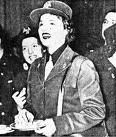
allidaveyNot that she hasn’t already been in front of my face. In the 1945 manifesto from the American Veterans Committee mentions a “Captain Alice B. Davey, WAC, Armed Forces Advisory Committee” on its list of leaders. But it wasn’t till that hissy fit last week that I started trying to track down if she were someone worth writing about. The answer of course, was more than yes: Major Alice Bradley Davey Sheldon, who her mom called “Alli,”  was more of a kindred spirit than I imagined.

I’d been looking for, as I said to friends, “a WAC vet with complex thoughts.” In Alli I also found a writer, a dreamer, a bisexual who described boot camp in her diary:

the long grey-green lines of women, for the first time in America, in the rain, under the flag, the sound of the band, far-off, close, then away again; the immortal fanny of our guide, leading on the right, moved and moving to the music—the flag again—first time I ever felt free enough to be proud of it; the band, our band, playing reveille that morning, with me on KP since 0430 hours, coming to the mess-hall porch to see it pass in the cold streets, under that flaming middle-western dawn; KP itself, and the conviction that one is going to die; the wild ducks flying over that day going to PT after a fifteen-mile drill, and me so moved I saluted them.

Of my characters from this war, she belongs more with John Huston, who withdrew to Mexico in 1980, than with Howard Zinn or William Kunstler or Philip Berrigan. Most of her stories only whispered their social critiques. But she lays it out pretty clearly in “The Women Men Don’t See,” a few exchanges after the one above:

“Men and women aren’t different species, Ruth. Women do everything men do.”

“Do they?” Our eyes meet, but she seems to be seeing ghosts between us in the rain. She mutters something that could be “My Lai” and looks away. “All the endless wars …” Her voice is a whisper. “All the huge authoritarian organizations for doing unreal things. Men live to struggle against each other; we’re just part of the battlefield. It’ll never change unless you change the whole world.”

Alli, you were half right. Thanks for your muscular telling of the paradoxes you saw.

(Many thanks to Julie Phillips, for working so closely to bring her to the world. If I can convey 1/10 of what you have, I’ll consider myself lucky.)

“we’ll see,” all right

wyler I think I hadn’t understood till now how completely radical it was to tell this story in 1946. Put it together with that Superman radio show, and you’d think telling truth to power was actually in vogue.

No wonder Willy Wyler, who saw his cameraman shot up over Europe, ended up having to fight Joe McCarthy too.

Diversity begins at home.

You’d think that someone who started out her interest in military-GI issues advocating for women in the military, working hand in hand with  the likes of Linda Grant de Pauw, Rep. Patricia Schroeder and  Captain Barb, who therefore knew about women in every war fought by the U.S, would have women as characters easily laced throughout the history I’m writing.

You’d think that a dyke who loved being able to give  Walt Whitman’s boyfriend voice in my Civil War chapter would be on the alert for the gays described by Allen Berube, who dissented in their very presence in World War II — and not have to had thown at me the compelling example of Guadalcanal vet Paul Moore, a running buddy of William Sloane Coffin. (Below is a clip of his daughter Honor, who wrote a book about his double life.)

And you might even think that a girl who is obsessed with Bayard Rustin and led her earlier chapters with dissenters of color —William Apess, Lewis Douglass, W.E.B. duBois— wouldn’t draft a chapter with a nearly all-white cast, with the exception of Medgar Evers. That a girl who squinted at and photocopied stuff from A. Philip Randolph’s Committee Against Jim Crow in the Armed Services would have naturally devoted a few lines to the NAACP’s 1942 “Conscientious Objectors Against Jim Crow.” That she’d at least have included 73-yr-old du Bois sighing that ‘ We fight for democracy not only for white folk but for yellow, brown, and black…We fight not in joy but in sorrow with no feeling of uplift.”

Nope: as currently drafted my World War II chapter, like the war itself, features an  all-male, nearly all-white cast. I slapped myself upside the head last night when I realized it. Better now than later, when Cynthia Enloe and Linda Bird Francke would do it more publicly on reading the final product.

To use the kind of language we used in the 1980s: I know I’m twisted by white privilege, but when did the frigging patriarchy decide to colonize my thinking?

Superman vs. the VFW?

In the department of stuff you come across while looking for something else, I found this radio show (the link brings on streaming audio). Click, and you can listen to a “thousands of GI’s” protesting “racial discrimination in state hiring,” and a kind of unusual ally has their backs: Superman, who flies in to stop the state troopers ordered to fire on the vets. Not unusual, it turns out, for the Superman radio show of 1940-1951, whose stories never appeared in comics and which also featured Superman vs. The Clan of the Fiery Cross (also known as the KKK).

This is all old news to true geeks, and doubtless other better writers than I, like  Michael Chabon. But I stumbled across it while poking around for something almost no one remembers (sort of my specialty): the American Veterans Committee.

AVC was a short-lived World War II veterans’ organization whose slogan was “Citizens First, Veterans Second.” And that story about the veterans protest was grounded in the same reality that gave AVC nearly a million members at its start.

By mid-1946, when that story ran,  literally 12,000 active-duty soldiers were busy protesting at bases around the world, accusing the Truman administrationof dragging its feet in getting them home. One famously told Truman, “Give us our independence or go home to yours!”  AVC, founded by the fellow below (who is not, as he seems, Orson Welles), had on its board civil rights icon Medgar Evers and Howard Zinn, among others. Many were writers, like Benjamin Bradlee and E.J. Kahn, and doubtless others found their way to that Superman show. In September of ’46, the AVC issued a special commendation to the producers of the show for its quiet linking of veterans with “social tolerance.”

bolteun

Actually, the VFW had issued a similar award the month before, though it was for promoting “the American way” – code for crushing “commie” stuff like those  “tolerant” Superman shows, which shut down in 1951 in favor of the commie-busting TV version.  No place in the new Cold War for such thoughts — or for a veterans group that saw itself as composed of angelic troublemakers (e.g.  sleeping in L.A. streets as a housing protest).  By the time the 1954  Senate Subcommittee Hearings on Juvenile Delinquency tamed Superman completely, the AVC had mostly collapsed under a not-unfamiliar perfect storm of personality clashes, sectarian-left noise (snooze) and McCarthyism. Leaving veterans of that war to choose between the American Legion and the VFW, as odious to them as to many OEF/OIF vets now.  Its founders basically did neither, choosing instead journalism, or film, or think tanks like the Carnegie Foundation for International Peace.

What happened next is still happening: some will be in the book. Stay tuned for some character sketches.

But I wonder if it would be too much of a cheat to lede my “necessary war” chapter with that fictional scene of “thousands of GIs.” (What do you think?)

So much for the loneliness of the long-distance runner

National Novel Writing Month? Me?

Normally, I’m one of those skeptical of the enterprise, the idea that a jillion people checking in online and pushing out 50,000 words had anything to do with producing quality work. Still, over the years I’ve thought of doing it, worried about it, then as I put aside the idea that fiction is what I do, mostly cheered on a friend or two from way on the sidelines.

But now, if I’m going to fulfill my contract with University of California Press, and deliver a 110,000 word nonfiction narrative by January 1 – desperate measures are called for. So when I got a note from the online community Red Room about participating in NaNoWriMo, I had one question: “Does it have to be fiction?”

The FAQ says nothing about nonfiction, so I decided to take the plunge.

After all, I just stopped calling myself a “novelist” three years ago. My book has plots, characters, more themes than you can shake a stick at and is as vivid as I can make it considering I can’t make shit up.

I’m hoping that adding the structure and mass mutual cheerleading of NaNoWriMo to my daily practice will add to my determination to produce against all odds – with little else that matters. I have six chapters, a prologue and an epilogue nowhere near drafted – and that doesn’t count fact-checking and revision. It’s still impossible. I’m still determined to do it. If it takes a jillion writers in a jillion cities, well, I never did put much stock in all that stuff about the loneliness of the long-distance runner.