Author Archives: chrislombardi

Unknown's avatar

About chrislombardi

Journalist, novelist, educator.

the WAC of my dreams

It’s a voice I hardly remember not having heard: the writer in the edgy science-fiction anthologies, the voice cool as ice, the material borderline radical. How many times did I read “The Girl Who was Plugged In” (turned later into an episode of Paradox), whose plaintive cyborg “Delphi” predated Blade Runner by decades?  Or the moment in “The Women Men Don’t See when the steely narrator tries to reassure a woman that she matters:

“Come on, why doomed? Didn’t they get that equal rights bill?”

Long hesitation. When she speaks again her voice is different.

“Women have no rights, Don, except what men allow us. Men are more aggressive and powerful, and they run the world. When the next real crisis upsets them, our so-called rights will vanish like—like that smoke. We’ll be back where we always were: property. And whatever has gone wrong will be blamed on our freedom, like the fall of Rome was. You’ll see.”

Now all this is delivered in a gray tone of total conviction. The last time I heard that tone, the speaker was explaining why he had to keep his file drawers full of dead pigeons.

“Oh, come on. You and your friends are the backbone of the system; if you quit, the country would come to a screeching halt before lunch.”

No answering smile.

“That’s fantasy.” Her voice is still quiet. “Women don’t work that way. We’re a—a toothless world.” She looks around as if she wanted to stop talking. “What women do is survive. We live by ones and twos in the chinks of your world-machine.”

“Sounds like a guerrilla operation.”

Frankly, I was never the HUGEST fan of James Tiptree, Jr, despite the Hugos and Nebulas and the knowledge that it was a pseudonym for a woman writer. I was kept at a distance by that detached voice, the same one that long convinced famous male writers like Robert Silverberg that the mysterious writer couldn’t be female, “for there is to me something ineluctably masculine about Tiptree’s writing.”  I’d never thought to buy the 2005 biography by Julie Phillips – I confess i didn’t even go to the extent of reading about it.

If I had, I’d have known that I’ve been looking for her for a long time.
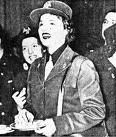
allidaveyNot that she hasn’t already been in front of my face. In the 1945 manifesto from the American Veterans Committee mentions a “Captain Alice B. Davey, WAC, Armed Forces Advisory Committee” on its list of leaders. But it wasn’t till that hissy fit last week that I started trying to track down if she were someone worth writing about. The answer of course, was more than yes: Major Alice Bradley Davey Sheldon, who her mom called “Alli,”  was more of a kindred spirit than I imagined.

I’d been looking for, as I said to friends, “a WAC vet with complex thoughts.” In Alli I also found a writer, a dreamer, a bisexual who described boot camp in her diary:

the long grey-green lines of women, for the first time in America, in the rain, under the flag, the sound of the band, far-off, close, then away again; the immortal fanny of our guide, leading on the right, moved and moving to the music—the flag again—first time I ever felt free enough to be proud of it; the band, our band, playing reveille that morning, with me on KP since 0430 hours, coming to the mess-hall porch to see it pass in the cold streets, under that flaming middle-western dawn; KP itself, and the conviction that one is going to die; the wild ducks flying over that day going to PT after a fifteen-mile drill, and me so moved I saluted them.

Of my characters from this war, she belongs more with John Huston, who withdrew to Mexico in 1980, than with Howard Zinn or William Kunstler or Philip Berrigan. Most of her stories only whispered their social critiques. But she lays it out pretty clearly in “The Women Men Don’t See,” a few exchanges after the one above:

“Men and women aren’t different species, Ruth. Women do everything men do.”

“Do they?” Our eyes meet, but she seems to be seeing ghosts between us in the rain. She mutters something that could be “My Lai” and looks away. “All the endless wars …” Her voice is a whisper. “All the huge authoritarian organizations for doing unreal things. Men live to struggle against each other; we’re just part of the battlefield. It’ll never change unless you change the whole world.”

Alli, you were half right. Thanks for your muscular telling of the paradoxes you saw.

(Many thanks to Julie Phillips, for working so closely to bring her to the world. If I can convey 1/10 of what you have, I’ll consider myself lucky.)

“we’ll see,” all right

wyler I think I hadn’t understood till now how completely radical it was to tell this story in 1946. Put it together with that Superman radio show, and you’d think telling truth to power was actually in vogue.

No wonder Willy Wyler, who saw his cameraman shot up over Europe, ended up having to fight Joe McCarthy too.

Diversity begins at home.

You’d think that someone who started out her interest in military-GI issues advocating for women in the military, working hand in hand with  the likes of Linda Grant de Pauw, Rep. Patricia Schroeder and  Captain Barb, who therefore knew about women in every war fought by the U.S, would have women as characters easily laced throughout the history I’m writing.

You’d think that a dyke who loved being able to give  Walt Whitman’s boyfriend voice in my Civil War chapter would be on the alert for the gays described by Allen Berube, who dissented in their very presence in World War II — and not have to had thown at me the compelling example of Guadalcanal vet Paul Moore, a running buddy of William Sloane Coffin. (Below is a clip of his daughter Honor, who wrote a book about his double life.)

And you might even think that a girl who is obsessed with Bayard Rustin and led her earlier chapters with dissenters of color —William Apess, Lewis Douglass, W.E.B. duBois— wouldn’t draft a chapter with a nearly all-white cast, with the exception of Medgar Evers. That a girl who squinted at and photocopied stuff from A. Philip Randolph’s Committee Against Jim Crow in the Armed Services would have naturally devoted a few lines to the NAACP’s 1942 “Conscientious Objectors Against Jim Crow.” That she’d at least have included 73-yr-old du Bois sighing that ‘ We fight for democracy not only for white folk but for yellow, brown, and black…We fight not in joy but in sorrow with no feeling of uplift.”

Nope: as currently drafted my World War II chapter, like the war itself, features an  all-male, nearly all-white cast. I slapped myself upside the head last night when I realized it. Better now than later, when Cynthia Enloe and Linda Bird Francke would do it more publicly on reading the final product.

To use the kind of language we used in the 1980s: I know I’m twisted by white privilege, but when did the frigging patriarchy decide to colonize my thinking?

where were you on December 9, 1980?

A few of us, in Binghamton, New York , stood in a circle and sang this song the day after Lennon died. We were already stunned by an electoral victory like last month’s, but in the reverse direction. We felt that we had just begun the worst of times.

Last night,  Elizabeth reports at my other shop, Yoko One was in Tokyo, memorializing John along with thousands of  Japanese youth too young to remember, but who know the Beatles playbook by heart.  Go see – and you’ll find Ann Northrop and Liza Minnelli, too,

zero hour, nine a.m.

It’s Pearl Harbor Day – a day I’m writing about right now in my chapter, when a lot of my characters felt put on notice.  And right now so do I, with my deadline screaming at me.  My most recent blogging has been at a Facebook page I put together for Ain’t Marching, rather than constantly clogging this one with meditations on spoiled priests and mortar blasts. (If you want to know more, please do stop by there.)

A few mostly-unmilitary matters I’ve meant to note here, though:

  • As most know, the country’s security is now largely in the hands of menopausal women. So much for invisibility.
  • Speaking of which,and in time for in time for the anniversary of the U.N  Convention on Genocide on Monday, here’s Christiane Amahnpour’s demand that we scream bloody murder, .
  • I finally saw Milk, and as expected cried like a baby. But did no one tell Gus van Sant, for the opening scene, that no subway staircase is *ever* that empty in the early evening? Or that quiet? (It comes quickly in the trailer below.) I know he’s used to less naturalistic forms, but that yell was developed in New York. May as well make it feel real.  In addition, I have mixed feelings about the ending, though I know the movie was already too long, but I wish van Sant had been able to do more than mention the trial of Milk’s assassin and the twin “White Nights.”The first link is to Jim Jones’ massacre, the second to a memory of that week in the Castro). Maybe  that should be a separate movie.

mumbai through a glass darkly

I swore yesterday to try to write nothing about Mumbai, besides linking to helpMumbai.com and NDTV. Certainly you should first read the reflections of Suketu Mehta, who I met at Nieman two years ago and thought of immediately this week. But I thought of something simple to bring to the party – spurred by  the 1982 film I finally saw  for the first time Friday night, which suddenly felt sort of timely. What would the guy above be feeling this week? (I’m not the only one asking, it seems.)

Above, you see Ben Kingsley as the young lawyer coaching fellow Indian-descent South Africans in the ways of satyagraha: later, in clips much less available, he strenuously opposes partition. But what did he say on the subject? I wondered.  I guessed rightly that better scholars than I had asked the same, and found what I was looking for here and here. (No doubt there’s even better than that by Indian scholars, but I’m still in baby steps here.)  Gandhi particularly saw the trouble that the two-state solution would mean for Bengal and for Kashmir – and he visited the latter, he wrote, he was heartened by the co-mingling of cultures, where acolytes of all religions had gathered to host him:

We have drunk the poison of mutual hatred and so this nectar of fraternization tastes all the sweeter and the sweetness should never wear out. … In the present exuberance one hears also the cry of “Long Live Hindustan and Pakistan,” from the joint throats of the Hindus and the Muslims.

But the political realities of each component elite (I’m not qualified to go into detail) crossed with British hurry to be rid of the expensive Raj – and the result is actually well limned in Deepa Mehta’s 1998 film, which led my fiancee to pledge war against all things British.

Given this week, I’m guessing Gandhiji would no longer do the same. We can only hope that the arc of history does bend toward justice – even if it’s as slow as he suggested in 1921:

gandhi1921“As yet I only see as through a glass darkly, and therefore have to carry conviction by slow and laborious processes, and then, too, not always with success.”

Superman vs. the VFW?

In the department of stuff you come across while looking for something else, I found this radio show (the link brings on streaming audio). Click, and you can listen to a “thousands of GI’s” protesting “racial discrimination in state hiring,” and a kind of unusual ally has their backs: Superman, who flies in to stop the state troopers ordered to fire on the vets. Not unusual, it turns out, for the Superman radio show of 1940-1951, whose stories never appeared in comics and which also featured Superman vs. The Clan of the Fiery Cross (also known as the KKK).

This is all old news to true geeks, and doubtless other better writers than I, like  Michael Chabon. But I stumbled across it while poking around for something almost no one remembers (sort of my specialty): the American Veterans Committee.

AVC was a short-lived World War II veterans’ organization whose slogan was “Citizens First, Veterans Second.” And that story about the veterans protest was grounded in the same reality that gave AVC nearly a million members at its start.

By mid-1946, when that story ran,  literally 12,000 active-duty soldiers were busy protesting at bases around the world, accusing the Truman administrationof dragging its feet in getting them home. One famously told Truman, “Give us our independence or go home to yours!”  AVC, founded by the fellow below (who is not, as he seems, Orson Welles), had on its board civil rights icon Medgar Evers and Howard Zinn, among others. Many were writers, like Benjamin Bradlee and E.J. Kahn, and doubtless others found their way to that Superman show. In September of ’46, the AVC issued a special commendation to the producers of the show for its quiet linking of veterans with “social tolerance.”

bolteun

Actually, the VFW had issued a similar award the month before, though it was for promoting “the American way” – code for crushing “commie” stuff like those  “tolerant” Superman shows, which shut down in 1951 in favor of the commie-busting TV version.  No place in the new Cold War for such thoughts — or for a veterans group that saw itself as composed of angelic troublemakers (e.g.  sleeping in L.A. streets as a housing protest).  By the time the 1954  Senate Subcommittee Hearings on Juvenile Delinquency tamed Superman completely, the AVC had mostly collapsed under a not-unfamiliar perfect storm of personality clashes, sectarian-left noise (snooze) and McCarthyism. Leaving veterans of that war to choose between the American Legion and the VFW, as odious to them as to many OEF/OIF vets now.  Its founders basically did neither, choosing instead journalism, or film, or think tanks like the Carnegie Foundation for International Peace.

What happened next is still happening: some will be in the book. Stay tuned for some character sketches.

But I wonder if it would be too much of a cheat to lede my “necessary war” chapter with that fictional scene of “thousands of GIs.” (What do you think?)

stray news, necessary wars and fantasy presidents

It’s been an odd week, since I last posted: and now an odd Thanksgiving, with attention split between the chapter I’m working on (more on that in a bit), family stuff, and the desire to check the latest from Mumbai, as one of those surreally-huge crises threatens to split the world and our brains. Below are some quick links, in lieu of a full post.

Why am I otherwise AWOL? I think it’s like those first weeks working on the Civil War chapter, when I was struck dumb by the hugeness of its pain. Now, writing about what most call The Good War,  I’m similarly cowed.  I do think my chapter’s title will borrow instead from Samuel Hynes, who writes and speaks of a “necessary war,”  as much of an oxymoron as that still feels.  (While I can’t claim to have come up with a satisfactory alternative, that phrase that still feels a contradiction — the tool of the Mumbai gunmen, not sensible people.)

I’ll provide a little more later, but meanwhile:

  • The “Hempstead 15,” that group of Iraq vets and activists arrested October 15 at Hofstra University, have secured equal treatment for their cases by the Nassau County DA’s office. Which is to say that they’ve received the adjournment in contemplation of dismissal (ACD) that was once standard for  direct-action types,  before the Patriot Act: further legal action will continue, with a lawsuit by Sgt. Nick Morgan, whose face was badly damaged when he was trampled, and with the court-martial of Sgt. Mathis Chiroux, who still faces trial for his May refusal to deploy to Iraq.
  • sarah_hale_portraitAt my other shop, an interesting riff on the woman who gave us the Thanksgiving holiday (and Vassar College), Sarah Josepha Buell Hale. While fact-checking the piece, I also found out that Hale’s son went to West Point, and suggested a poem by one of my almost-characters on her magazine: Edgar Poe, he son wrote, “is seen as a man of talent here, but he is too mad a poet to like mathematics.” That line could title a biography.
  • On the good-news front, the reviews of Milk are even better than I’d hoped. Milk, writes David Denby in the New Yorker,  “comes across as an idiosyncratic man, a rule-bound New York Jew who finds his calling in the beautiful and sensually relaxed Mediterranean-style city.” This Bronx shiksa felt the same way for a few years of my life.
  • As for Mumbai, I will not make the mistake of many whose business it is to chat, and default to some usual position — e.g. Fox positing a delay in closing Guantanamo or the rumors of Obama-staff presence that led normally sober media temporarily astray. But here’s the helpMumbai Page, for any Mumbaikers or travelers who might stumble here and want to know how to get/give concrete assistance.
  • And because it’s Thanksgiving week, I’ll give in to the temptation to end with a video joke — but of my geeky sort, which was fortunately shared by enough others to make this clip a Youtube favorite:

and we wonder why we’re invisible

When the frigging  New York Times “Public Editor” is that clueless:

I said incorrectly last week that Matthew Shepard had been murdered in Colorado. He died in a hospital there. Thank you to readers who pointed out that the fatal beating took place near Laramie, Wyo.

It was all over the news, sir. Before you went to press, you could have double-checked, using The Google. Or even Youtube: